 KidneyCats
 Your cat's bloodwork, translated
The short answer
Creatinine and SDMA are waste products her kidneys should be clearing, and they're what her stage is based on. Phosphorus drives how ill she feels. Potassium drives how strong she feels. Urine protein and blood pressure decide her treatment. Each is a separate problem with a separate fix.
If you have the sheet in your hand, put the numbers in and I will read them with you.
Read her numbers
Type what is on the sheet. This does the same lookup as the IRIS chart, and adds phosphorus against her stage and what I would do first. Nothing leaves your phone.
What you're looking at
Find the printout your vet gave you. It'll have a column of names, a column of numbers, and a reference range beside each one so you can see what's high and what's low.
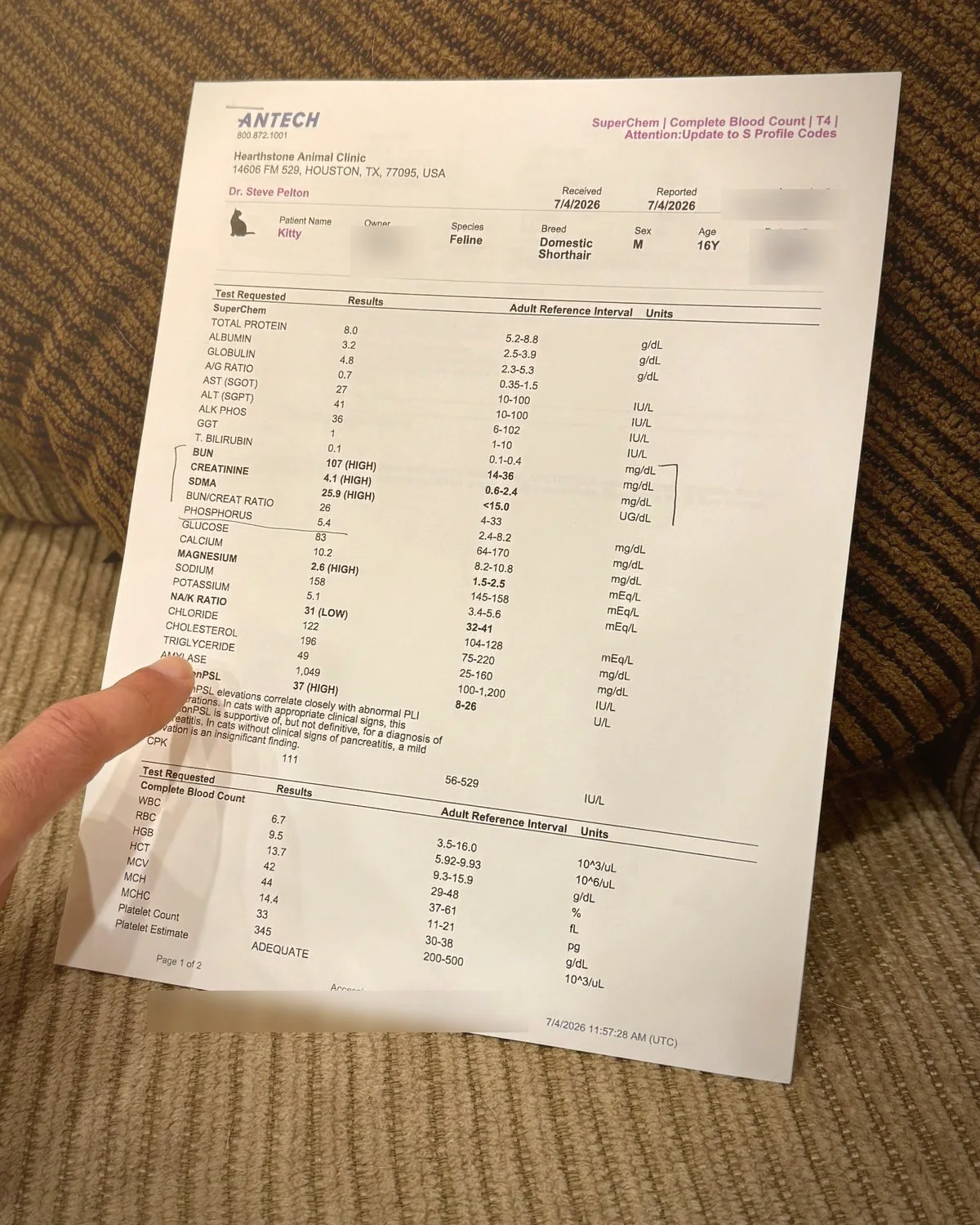
That's one of mine. Yours will look much the same: the names down the left, your cat's number next to each one, and the range a healthy cat should sit in beside that.
Here's what each of them is actually telling you, in the order I'd read them.
Tap any value on the sheet
A lab sheet has about six lines that matter in this disease. Here they are, in the order I would read them.
ANALYTEUNITSREFERENCE
A waste product from normal muscle activity that healthy kidneys filter out. As kidney tissue is lost, it builds up in the blood.
Her IRIS stage is based on this one, so it is the number that gets quoted most. Two things skew it: dehydration pushes it up, and lost muscle pulls it down.
Another waste product, and a more sensitive one. It starts rising earlier than creatinine, sometimes a year or more earlier.
This is usually the value that catches the disease in the first place, often on a routine senior panel in a cat who seemed perfectly well. Earlier is better, even though it does not feel like it.
Blood urea nitrogen. Another waste product, and the least useful of the three on its own.
It moves for reasons that have nothing to do with kidneys: a high-protein meal, dehydration, or bleeding into the stomach or intestines. Your vet reads it alongside creatinine rather than by itself.
A mineral failing kidneys cannot dump properly, so it accumulates.
This is the one to work hardest on. High phosphorus makes cats nauseated and flat, and it speeds the disease along. Unlike creatinine, we can move it, with diet or a binder. Ask what number your vet is aiming for in her specifically, because the IRIS target for the later stages is tighter than the plain range printed on the sheet.
Drives muscle strength, and kidney cats get into trouble with it in both directions.
Low is the common problem early and in the middle, because damaged kidneys leak it into the urine. High happens late, when she is producing little urine, and it affects the heart. A supplement that was right at stage 2 can be harmful at late stage 4, so never start, stop or change one on your own.
The proportion of her blood made up of red cells. Anemia shows up here.
Failing kidneys make less of the hormone that tells the bone marrow to produce red cells. This is mostly a later-stage problem, it is treatable, and a fast fall matters more than a settled low number.
Not on the blood panel, and both are treatable
Urine protein to creatinine ratio. It needs a urine sample, so it is not on the blood panel at all, and plenty of cats have never had one run.
Under 0.2 is normal, 0.2 to 0.4 is borderline, above 0.4 is proteinuric. Protein loss makes the disease progress faster and there is a specific medication for it your vet will not prescribe without the number. If you ask for one thing after reading this page, ask for this.
Also not on the blood panel. It needs equipment a lot of practices do not own.
Under 140 is normal, 140 to 159 prehypertensive, 160 to 179 hypertensive, 180 and above severe. Between one in five and one in three kidney cats is hypertensive, and it usually causes no symptom until it causes a permanent one, most often sudden blindness.
A single value on a single day is not a verdict. The line across three or four visits is what tells the story, which is why your vet keeps asking you to come back rather than reading you today's sheet.
Two things worth knowing before you start. Numbers move around, and one bad result on one day isn't a verdict. And the trend across several visits matters far more than any single value, which is why your vet keeps asking you to come back rather than just reading you today's sheet.
Creatinine
A waste product that comes from normal muscle activity. Healthy kidneys filter it out. As kidney tissue is lost, it builds up in the blood.
This is the number your cat's IRIS stage is based on, so it's the one that gets quoted most.
Two things skew it, and both matter: dehydration pushes it up, and lost muscle pulls it down, so a thin cat's creatinine may be flattering her. Both are worked through on the IRIS stages page, under why her stage might be wrong. And if the number has you doing survival math at midnight, life expectancy by stage is the honest version, medians, ranges and all.
SDMA
Another waste product, and a more sensitive one. It starts rising earlier in the disease than creatinine does, sometimes a year or more earlier.
SDMA is usually the value that catches kidney disease in the first place, often on a routine senior panel in a cat who seemed perfectly well. If that's how you got here, that's genuinely good news even though it doesn't feel like it. Earlier is better.
BUN
Blood urea nitrogen, another waste product. It's on every panel and it's the least useful of the three for judging kidney function on its own.
The reason is that BUN is easily shifted by things that have nothing to do with kidneys. A high-protein meal raises it. Dehydration raises it. Bleeding into the stomach or intestines raises it, sometimes a lot. Your vet looks at it alongside creatinine rather than on its own.
Phosphorus
This is the one I work hardest to control, and if you only take one value away from this page, take this one.
Failing kidneys can't dump phosphorus properly, so it accumulates. High phosphorus makes cats feel unwell. Nauseated, flat, off their food. It also speeds the disease along, so it isn't only a comfort issue.
Unlike creatinine, we have real control here. Lowering phosphorus is what a kidney diet is mostly for, and what a phosphorus binder does directly.
Potassium
Potassium drives muscle strength, and kidney cats can run into trouble with it in both directions. This is the part that's usually explained badly, so read it carefully.
Low potassium is the common problem, in the earlier and middle stages. Damaged kidneys leak potassium into the urine. A low cat is weak and wobbly, sometimes walking as though the floor is uneven, and classically holding her head and neck oddly low. That's a real sign with a real name, and it corrects with a supplement.
High potassium happens in late-stage disease, and it's dangerous. When the kidneys are failing badly enough that she's producing little urine, potassium builds up instead of being lost. High potassium affects the heart.
The reason this matters to you: a supplement that was exactly right for her in stage 2 can become actively harmful in late stage 4. Potassium is decided on a blood value, rechecked, not on symptoms and not on last year's prescription. Never start, stop, or change a potassium supplement on your own.
Urine protein, the value that's often missing
This one isn't on the blood panel, and plenty of cats have never had it done.
A UPC, urine protein to creatinine ratio, measures whether the kidney's filters are leaking protein into the urine. It matters for two reasons. Protein loss makes kidney disease progress faster, and it's treatable with a specific medication that your vet won't prescribe without the number.
Along with blood pressure, UPC is what IRIS calls substaging. A stage on its own is an incomplete picture. Of the two, the UPC is the one I'd chase: it's widely available, it's cheap, and it changes treatment. If your cat has a stage but has never had one run, that's a reasonable thing to ask about.
Blood pressure
Also not on the blood panel, and this one comes with an honest caveat.
Roughly one in five to one in three cats with kidney disease has high blood pressure. It usually causes no symptoms at all until it causes a sudden and permanent one, most often blindness from a detached retina. So it's worth knowing about.
But measuring it well in a cat is harder than it sounds, and the equipment is expensive. I don't have it at my clinic, and plenty of other practices don't either. If yours does, it's worth asking for. If yours doesn't, that isn't a sign you're in the wrong place, and it isn't something to lose sleep over. Cats are managed well without the number every day.
What doesn't need a machine is watching her eyes. Pupils that are wide and stay wide, or a cat suddenly bumping into things, is a same-day phone call. There's more on all of it, including why the reading is so slippery in cats, on the blood pressure page.
Red blood cells, later on
Further down the sheet you'll find hematocrit or PCV, which is the proportion of her blood made up of red cells.
Healthy kidneys make a hormone that tells the bone marrow to produce red cells. As kidney tissue is lost, that signal fades and cats become anemic. It's a later-stage problem, it's treatable, and treating it can transform how an advanced cat feels.
What to actually do with all this
Write down four numbers after every recheck: creatinine, phosphorus, potassium, and her weight. Put them in the notes app on your phone with the date.
That's it. Six months from now, when you're trying to work out whether things have changed, you'll have a straight answer instead of a guess. It's the single most useful thing I ask owners to do and almost nobody does it.
Questions people ask me about this
- What is a normal creatinine for a cat?
- Most labs print something around 0.8 to 2.4 mg/dL, but read your own sheet, because ranges differ from lab to lab. One value matters far less than the line it makes across several visits, and less again if she was dry on the day of the draw.
- What's the difference between creatinine and SDMA?
- Both are waste the kidneys are supposed to clear. SDMA moves earlier, sometimes a year or more before creatinine budges, which is why it's usually the test that finds the disease at all. Creatinine is the one her stage is built on.
- Why does my vet keep talking about phosphorus?
- Because it's the value that most changes how she feels day to day, and the one we can actually pull down. High phosphorus makes cats nauseated and flat and shortens the course. Diet or a binder moves it, and moving it is the most useful thing on the whole list.
- What is a UPC and why does my cat need one?
- The urine protein to creatinine ratio, which measures whether her filters are leaking protein. It matters because leaking protein shortens the course, and because there's a drug for it your vet can't prescribe without the number. Plenty of cats have never had one run, so ask.
- Does my cat need her blood pressure checked?
- Worth doing wherever it can be done: one in five to one in three kidney cats is hypertensive, and it can take her sight overnight. Plenty of practices don't own the equipment, and those cats are still managed well. Your part is watching her eyes and calling the same day if anything changes.
- My cat's numbers went up. Does that mean she's getting worse?
- Not on its own. Dehydration, an infection, constipation, even a bad car ride can lift a panel for a week. Recheck before anyone reads anything into it, because four values make a line and one makes a dot.
Medically reviewed by Dr. Steve Pelton, last updated . First published . Reviewed quarterly.